Bessemer City and Township Fire Departments
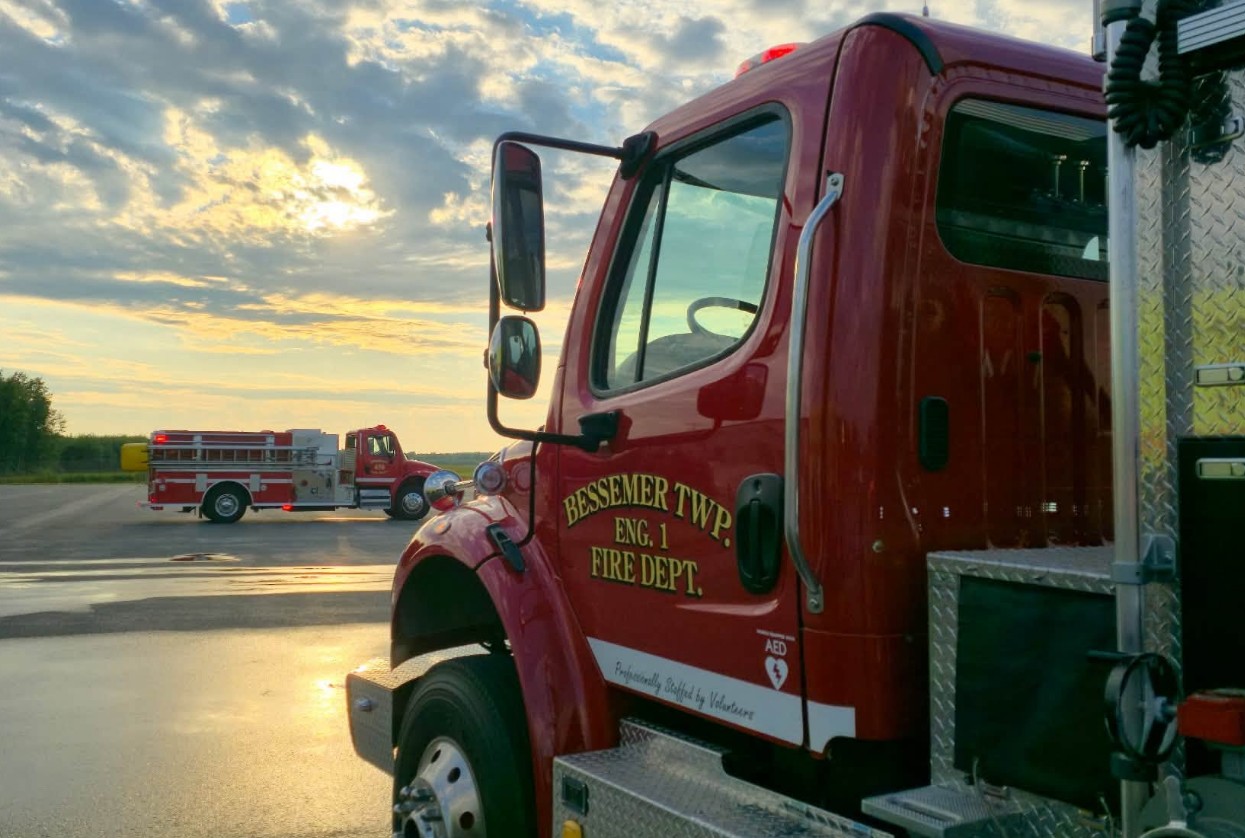
| City Department | Township Department: |
|---|---|
| -2026-2027 Budget: $27,300 -Membership: 12 members, 4 shared -Average time to arrive at station and geared up to respond to call outs: 5 – 10 minutes -Average number of calls in a year: 20 including structure fires, power lines, car accidents, mutual aid with other departments, and occasional brush fires. -Fire Hall: Built in 1937. Currently is severely limited in size for fire trucks. The mirrors of truck 5 were shortened after purchase to fit through the door. There are no exhaust fans or venting inside the building. -Current fire apparatuses: Two engines with 1,250 GPM pumps and 1,250 gallon capacity. |
-2026-2027 Budget: $37,000 -Membership: 11 members, 4 shared -Average time to arrive at station and geared up to respond to call outs: 5 minutes -Average number of calls in a year: 24 including brush/wildfires, car accidents, structure fires, power lines, and mutual aid with other departments. -Fire Hall: Built in 1923. Currently is severely limited in size for fire trucks. Engine 1 had to be customized around the fire hall. There are no exhaust fans or venting inside the building. -Current fire apparatuses: One engine with 1,250 GPM pump and 1,250 gallon capacity. Two tankers with 500-750 GPM pumps and around 2,000 gallon water tanks. |
Fire Trucks
BTFD Engine 1-2016 Freightliner M2 ,BTFD Tanker 281- 2015 Freighterliner M2, BTFD Tanker 98- 1998 International 4900,
Shared Requirements and Costs
Training Requirements per Firefighter:
296 hours of state training to obtain certification. Members are required to complete this training as soon as possible, but generally in the first two years. To keep the certification, fire fighters must complete 36 hours of in-house training over a three-year time span. The City and Township departments currently train together once a month for approximately 2 hours. Certifications stay with the individual so long as they complete their continuing education.
Meetings:
Each department has one meeting per month to conduct regular business including truck checks, hall maintenance, membership decisions, and other activities for a total of 12 meetings per year.
Cost of Gear:
A new fire engine*, also called a pumper, costs around $500,000 for a basic build or up to $800,000 for a custom truck. Engines are the most common type of fire response vehicle. Typically, these trucks carry a dedicated water tank, high-capacity water pump, hose lines and ground ladders, and basic specialize equipment for suppression.
A new fire tanker*, also called a water tender, costs between $200,000 to
$650,000 depending on many different factors. These trucks are used in rural communities without hydrant systems. They are designed to transport large amounts of water, often 2,000 to 4,000 gallons or more, to support continuous water delivery when hydrants are unavailable. These work well in extended fire suppression operations.
* The National Fire Protection Association (NFPA) recommends shifting trucks from active duty to reserve status at the 15-year mark and suggests removing apparatus from service entirely at the 25-year mark. Some departments or local standards evaluate front-line replacement starting at the 10-year mark, while others watch usage of metrics rather than age alone.
Turnout Gear includes radio, helmet, glove, hood, boots, bunker pants and coat. The total cost for everything is $13,500 to outfit a single fire fighter. It is recommended to have a spare set for each fire fighter.
Air Packs and Bottles, or Self-Contained Breathing Apparatus (SCBA), are needed for each fire fighter with a couple of extras per department. They cost approximately $12,000 per pack. Both departments need to update these with about 16 new sets needed per department to be totally up to date.
Cascade Systems are used to refill the bottles used for air packs. A new system costs between $15,000 and $20,000. The City needs a new system in order to refill bottles as they are used.
Jaws of Life/Extrication Equipment can vary in cost, but a package used in rescue operations can be from $7,500 to over $25,000. The Township has a
“newer” set of equipment from 2007, but both departments could use an update.
Annual Testing is required for many different equipment. Trucks need to be pump tested annually for around $500 per truck plus mileage. Hose testing needs to be completed annually but can be done in house. SCBA flow testing is required annually by an outside company as well.
There are many other smaller tools and gear that are set up on the trucks or carried by members depending on the situation that can’t all be named here. Keeping updated, well-maintained gear allows fire fighters to safely and efficiently handle an emergency.
Fundraising and Grants:
The departments annually work on fundraising to help offset the cost of new equipment. This takes time and hard work from members of the department. Funds raised vary drastically year to year. Members also take time to visit schools and attend events to promote fire education and inform the public about the departments.
Both departments submit grant applications at least twice per year. As soon as someone hears about a grant opportunity, both departments submit their own application. In the last year, both the City and Township have applied for a larger grant through the State of Michigan for $50,000 and have yet to hear back. The City has applied for a recurring grant for the last 3 years without success. While sometimes smaller grants are awarded, such as the 2025 Mi DNR grant for wildland gear for the Township, grant opportunities are overall limited for rural fire departments.
Fire Fighter Pay:
Both departments operate as Volunteer Fire Departments. Members do receive some pay based on the number of callouts, meetings, and training they attend in the year, but this amount is significantly less than $3,000 annually. The total combined budget for wages between the two departments equals $29,550.
In comparison, estimated fire fighter annual wages in Michigan in 2023 were between $46,780 to $53,390 according to the US Bureau of Labor Statistics.
The requirements placed on fire fighters in regards to training, availability, and overall responsibility are not too different between the two types of employment, but the benefits differ greatly. Our members take this job on not for money, but to help protect the community.